Review
The American at St. James's. The Devil's Organ by Jens Korndörfer
The American at St. James's. The Devil's Organ by Jens Korndörfer
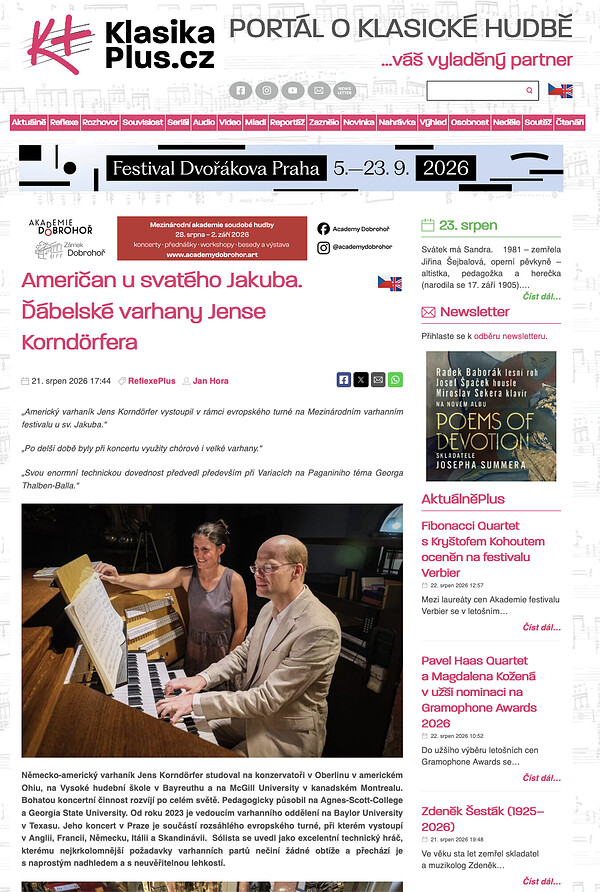
“American organist Jens Korndörfer performed at the International Organ Festival of St. James as part of his European tour.”
“After a long time, both the choir and the large organ were used in the concert.”
“He demonstrated his enormous technical skill especially in the Variations on a Theme of Paganini by Georg Thalben-Ball.”
German-American organist Jens Korndörfer studied at the Oberlin Conservatory in Ohio, the Bayreuth School of Music, and McGill University in Montreal, Canada. He has been active in concert activities all over the world. He has taught at Agnes-Scott-College and Georgia State University. Since 2023, he has been head of the organ department at Baylor University in Texas. His concert in Prague is part of an extensive European tour, during which he will perform in England, France, Germany, Italy, and Scandinavia. The soloist has established himself as an excellent technical player who has no difficulty with the most demanding organ parts and overcomes them with complete clarity and incredible ease.
The concert's pleasant opening number was the use of the choir's small Baroque organ on the right side of the choir, which, to our detriment, is rarely heard at the festival. Toccata VII by Georg Muffat, a native of Savoy, is part of a remarkable cycle of toccatas called Apparatus musico-organisticus from the end of the 17th century. Muffat studied in Paris and Italy, and worked as an organist and bandmaster in Vienna and Passau. He absorbed the influences of French, Italian and German music. Jens Korndörfer captured the moody variability of the six contrasting parts of the Toccata, underlined by an imaginative registration.
However, he had already played other pieces on the large organ. One of Johann Sebastian Bach's greatest organ pieces is the Prelude and Fugue in E minor BWV 548, which his biographer Philipp Spitta calls an organ symphony. The Prelude is not, as the name suggests, just a kind of prelude to the following fugue, but an extensive serious section that forms a perfect harmonic whole with the fugue with its wonderful chromatic theme. The fugue alternates polyphonic fugue sections with virtuoso toccatas. The soloist conceived the prelude and fugue sonically in a smaller mixture envelope and in the prelude in a considerably fast tempo, which did not benefit the seriousness of the piece much and did not help its perfect polyphony to become more clear and understandable.
George Thalben-Ball is of Australian origin, but his entire career belongs to England. He worked in London as a pianist, choirmaster and organist at Temple Church. He wrote Variations on a Theme by Paganini, or rather on his Capriccio No. 24 for solo violin. He was not the first to be enchanted by this theme. Johannes Brahms had already used it in his piano variations and Sergei Rachmaninov in his Rhapsody on a Theme by Paganini for piano and orchestra. Thalben-Ball's Variations are composed in the traditional spirit, but the curious thing about the piece is that they are written only for the solo pedal. Only at the end did the hands on the manual join in to enhance the effect of the piece. The camera from the choir very usefully and appropriately transmitted the organ playing to the pedal, because in some variations there was a chordal play that, at least in three voices, sounded so incredible that it is surprising what one person and only two legs of the organist can manage. The soloist took advantage of the opportunity and showed his enormous technical skills in the best light. The variations using the passages were played and won at a devilish pace, the chord parts, despite all their enormous difficulty, sounded as natural as if they were a completely simple matter. The movement of the organist's legs was reminiscent of a dancer in a ballet performance, but it was carefully worked out and very economical.
The concert concluded with Maurice Duruflé's Suite Op. 5. The composer worked as a long-time organist at the St-Etienne-du-Mont church in Paris and as a professor of theoretical subjects at the Paris Conservatory. He was very critical of his work, which is why he did not create many compositions. The three-movement Suite Op. 5 from the 1930s continues the fading impressionism and is very distinctively stylized in terms of instruments. Here the soloist gave a very disciplined and concentrated performance. The St. James instrument provided him with many opportunities to apply subtle instrumental colors. He kept the dark opening Prelude in a solid shape and impressively escalated the composition to the climax and calming conclusion. In the following Siciliana, a charming melody sounded softly and tenderly, alternating with chords in almost inaudible sliding registers. The final, spectacular, dramatic and stormy Toccata, with its irregular rhythmic beats and captivating conclusion, contributed to the successful outcome of the entire concert.