Review
Sublime Organ Artistry between Romanticism and 20th-century virtuosity
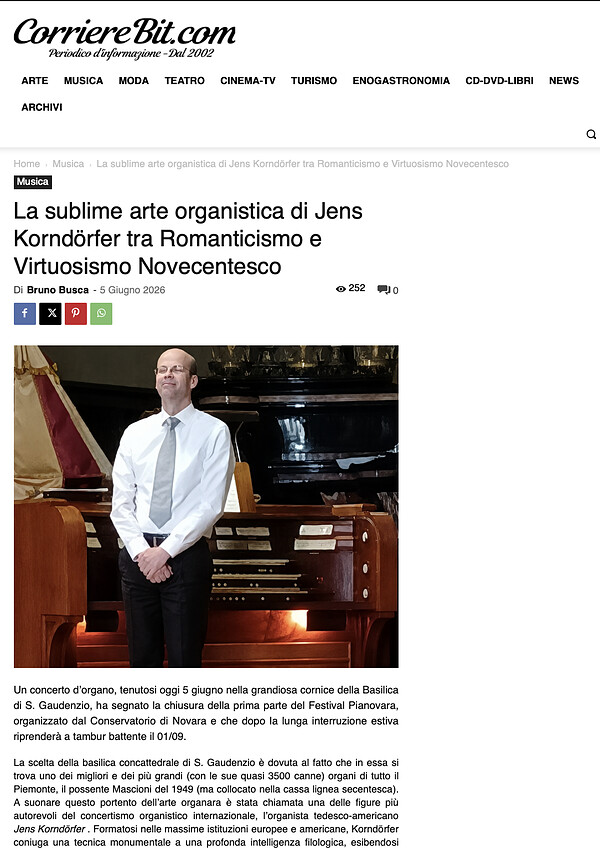
The sublime organ artistry of Jens Korndörfer: between Romanticism and 20th-century virtuosity.
An organ concert held today, June 5th, within the magnificent setting of the Basilica of San Gaudenzio marked the conclusion of the first part of the Pianovara Festival. Organized by the Novara Conservatory, the festival will resume in full swing on September 1st following the long summer break.
The Basilica of San Gaudenzio was chosen because it houses one of the finest and largest organs in Piedmont—boasting nearly 3,500 pipes—the mighty Mascioni instrument built in 1949 (though housed within a 17th-century wooden case). To play this masterpiece of organ craftsmanship, the organizers invited one of the most authoritative figures on the international organ concert circuit: the German-American organist Jens Korndörfer. Trained at leading European and American institutions, Korndörfer combines monumental technique with profound musicological insight; he performs at the world’s most prestigious venues with a vast repertoire spanning from the Renaissance to the contemporary era. His signature style lies in his ability to transform the organ into a polyphonic orchestra, achieved through masterful management of registration and absolute control over dynamics. The concert offered an extraordinary showcase of organ literature from the 19th and 20th centuries, highlighting both the instrument's versatility and the performer's analytical precision.
The concert opened with William T. Best’s celebrated transcription of the Overture to Felix Mendelssohn-Bartholdy’s oratorio *St. Paul*. Korndörfer approached Mendelssohn’s dense orchestral writing with a decidedly solid interpretive approach. In particular, the German-American organist recreated the 19th-century orchestral blend by using foundation stops (Principals and Flutes)—refinedly combined with soft reeds for lyrical passages—while supporting the phrasing with an excellent execution of the dynamic crescendo in the fugal section. Korndörfer’s use of the swell box was of pinpoint precision, avoiding any abrupt shifts in sound. Added to these excellent interpretive qualities was the absolute transparency with which the soloist’s hands unravelled the polyphonic lines of the contrapuntal writing, maintaining impeccable clarity of articulation throughout. With the subsequent *Fantasia in A minor* (from *Trois Pièces*) by César Franck, the performance entered the heart of late 19th-century French organ symphonism. Overall, the rendition of this piece confirmed Korndörfer’s refined interpretive gifts; he succeeded in preserving the drama of the theme through rigorous formal control of phrasing and musical lines, while securing—with rare technical and tonal mastery—the deep, mystical sound essential to Franck’s organ literature. Particularly admirable was the impeccable *legato* with which the pedal—deep yet never overpowering—supported the harmonies (characterized by typical Franckian chromaticism) and the constant key changes. To enhance the expressive power of this beautiful piece, Korndörfer handled the transitions between meditative sections and dramatic peaks—which recur frequently in the score—with intense evocative force. With the final two works on the program, we leave the 19th century behind and move into the heart of the 20th. The third piece featured was by George Thalben-Ball (1896–1987)—a pillar of the British organ tradition renowned for his legendary technique; his *Variations on a Theme of Paganini* (a study for pedals based on the famous Caprice No. 24) represent an extreme technical challenge, being written exclusively (or nearly so) for the pedalboard—a so-called *pedaliter* performance that gave Korndorfer the opportunity to deliver a stunning display of both ‘athletic’ and musical virtuosity.
The performance of the Variations demonstrated extraordinary heel-toe pedal technique: Korndörfer tackled passages involving double and triple notes with a beautiful, fluid *legato* and truly admirable, geometric precision in both pedaling and articulation. To ensure the lightning-fast scales and octave leaps on the pedalboard remained audible, the organist built a solid sonic blend using 8′ and 4′ foundation stops coupled with mutation stops, which ensured crisp tonal definition of individual harmonics, even in the lowest registers. The final composer on the program, the Frenchman Maurice Duruflé (1902–1986), embodies the quintessence of French mysticism, combining Gregorian chant with highly refined, Impressionist-inspired harmony. His Suite, Op. 5, is a cornerstone of the 20th-century repertoire; Korndörfer performed its three movements with a vision that could best be described as ‘monumental.’ In the opening Prelude—a somber, solemn movement—the performer created a compelling, hypnotic atmosphere by combining the organ’s dark foundation stops, eliciting an almost dreamlike sound from the *Principals* and *Bourdons*. The gradual entry of the *Plenum* and reed stops—powerful and penetrating during the central climax—overwhelmed the listener with its sonic density before fading into silence, while the subsequent *Sicilienne* offered a moment of pure tonal poetry: here, Korndörfer showcased his mastery of registration, isolating the famous pastoral theme on a solo *Cromorne* or *Oboe* stop, set against a backdrop of floating strings and flutes. His flexible, elegant phrasing perfectly captured the piece’s Impressionist grace. Finally, the *Toccata* presented a work of transcendental technical difficulty. Korndörfer’s rhythmic precision was pinpoint-accurate in the complex *manualiter* sixteenth-note patterns—executed without the pedalboard—while the pedals articulated the main theme with commanding power, underpinned by the deep reed stops. It was a rousing finale, in which the performer’s dynamic control and physical stamina drew thunderous applause.
Jens Korndörfer’s concert was distinguished by a perfect balance between musicological rigor and spectacular performance. His ability to master the complex mechanism of the organ—adapting stops and dynamics to the demands of widely differing styles—demonstrated his interpretive greatness, resulting in an evening of immense cultural value; it celebrated the organ not merely as a liturgical instrument, but as the undisputed star of the grand concert hall—a role into which even a basilica nave can sometimes transform. In response to the audience's warm applause, which signaled the concert's resounding success, Korndörfer played an unlisted encore—a piece we confess we could not identify, yet one whose elegance and refined phrasing made it a fitting conclusion to this magnificent performance.